The Creator Factory Is Here
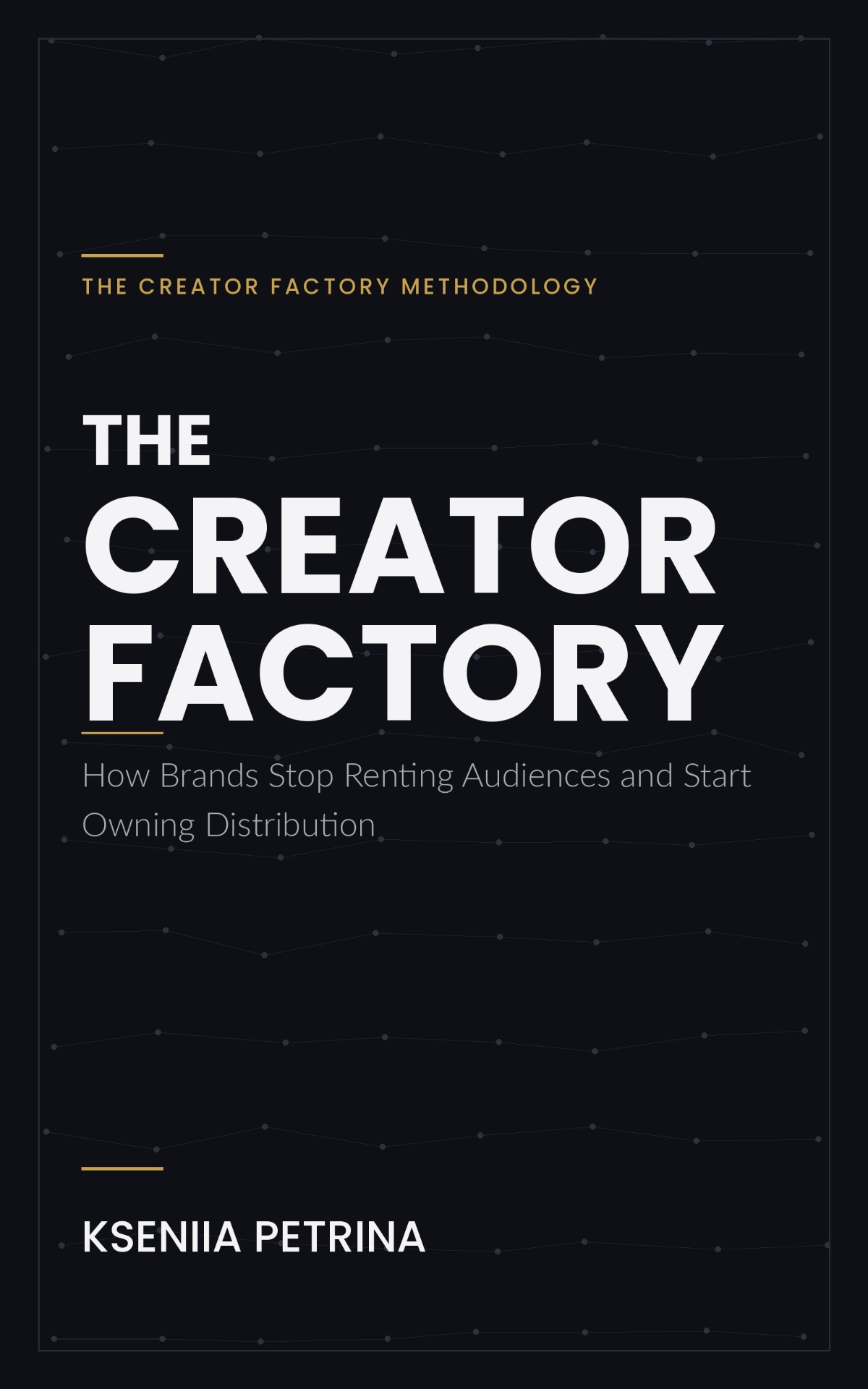
For the better part of a decade, I’ve watched brands spend billions of dollars on influencer marketing and measure almost none of it correctly. So I wrote a book about it. The Creator Factory: How Brands Stop Renting Audiences and Start Owning Distribution is out now on Amazon.
Here’s the whole argument in one sentence: most brands are renting audiences when they should be building them.
The mistake everyone’s making
Brand spending on influencer marketing crossed $32 billion last year. And the dominant way teams account for that spend is still transactional: you find a creator with a desirable audience, you pay for access for the length of a campaign, you count the impressions, and the next quarter you start over from zero. The campaign ends, the audience goes back to its owner, and nothing remains on your balance sheet but a report.
I call this the rented-audience model, and The Creator Factory is an argument against it — not on ideological grounds, but on arithmetic ones. As long as you treat every campaign as a closed transaction, paid advertising will almost always look cheaper, because it has no compounding asset on the other side of the ledger. Neither does most influencer marketing, the way it’s practiced today.
There’s a third option, and it’s the one the book is built around: stop renting other people’s audiences and start building your own distribution infrastructure — a system of creators you recruit, train, scale, and retain as long-term, owned channels. One of our clients grew this way to more than 800 brand-owned accounts. That’s not a series of campaigns. That’s a media asset.
What’s inside
I wrote the book the way I’d actually explain this to a CFO, because the CFO is usually the person who senses something is wrong with the influencer line item but can’t name it. It’s organized in four parts:
- The math. A three-year model comparing renting versus owning, with the seven variables that make or break a creator program. The factory honestly loses to renting in year one — and you need to know exactly why before you start.
- What 8,000 collaborations a year taught us. Four findings that cut against industry intuition, including the one that gets the most argument: AI content generates reach, but it doesn’t generate sales. Reach is a transaction with spectacle. A purchase is a transaction with trust. AI, so far, produces the first and not the second.
- The contrarian positions I won’t let go of. Small creators beat big ones on cost per customer. B2B is the arbitrage almost no one is taking. And Latin America is not one market — it’s twenty-plus, and the brands that treat it as one fail with a regularity that qualifies as the most expensive stereotype in international marketing.
- The build. A quarter-by-quarter operating plan, the five mistakes that kill creator factories, and — because a book that sells a model without contraindications is a brochure — an honest chapter on when not to build one at all.
Who it’s for
If you control a marketing budget and you’re tired of choosing between “reach” and “performance,” The Creator Factory is written for you. It’s not a manifesto and it’s not a memoir. It’s the economics, the mechanics, and the field-tested system behind owned distribution — with every external number sourced, and the internal ones presented in aggregate so you can run the math on your own.
The market isn’t going to wait. The cost of paid attention rises every year. Trust in synthetic content is falling faster than its production gets cheaper. Audiences are getting sharper at telling a human voice from a logo. Each of those trends, alone, is an inconvenience. Together, they’re a verdict on any model where a brand owns none of its distribution.
The brands that get this are already building. If you want the blueprint, the book is here.
The Creator Factory is available now on Amazon in paperback and Kindle.